How Big Is a Storage Unit? A Gainesville Size Guide
Storage unit sizes trip people up because they're advertised in feet, but what actually matters is what fits inside — and that's easier to picture in terms of rooms and furniture than square footage. Here's how sizing actually works, what each common size holds in practice, and what it costs in Gainesville.
How storage units are measured
Units are advertised as width × length — a 5×10 unit is 5 feet wide and 10 feet deep. Most run about 8 feet tall, though that varies by building.
Height matters more than people expect. A 5×10 unit isn't just 50 square feet of floor — it's roughly 400 cubic feet once you account for stacking. Most of a unit's usable capacity is vertical, which is why two units with the same footprint can hold very different amounts depending on ceiling height and how efficiently the space is packed.
Facilities cap stacking height to stay clear of sprinkler heads and fire suppression systems — sometimes marked by a solid wall, sometimes by wire mesh or open bars above about 8 feet. Whatever the marker, don't stack above it.
Reduced-height units and storage lockers
Some facilities offer smaller, shorter spaces — often listed as "5×5×5," "storage locker," or "reduced height" — usually 25 square feet or smaller, sometimes with rolling stair access in multi-story buildings. These run cheaper and work well for boxes, luggage, seasonal items, and small personal belongings — a common pick for a UF student storing dorm essentials over the summer rather than a full apartment's worth of furniture.
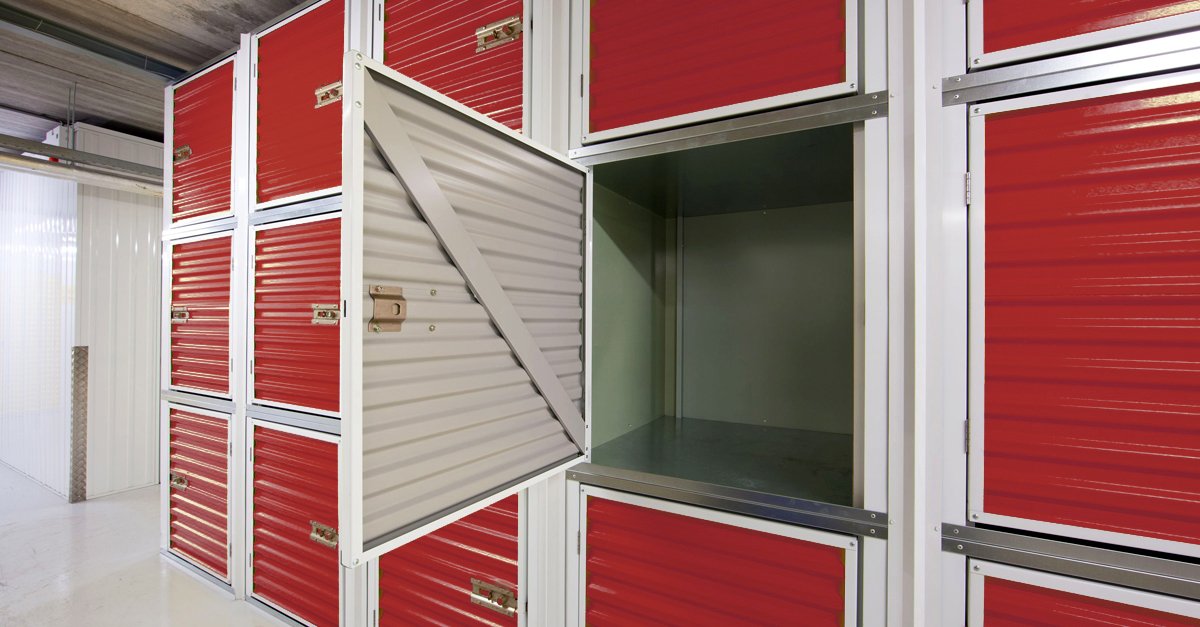
Storage Lockers
Access types worth knowing
Drive-up — park directly outside the unit for the fastest loading and unloading.
Ground-level — first floor, no stairs or elevator, but not necessarily drive-up.
Elevator access — common in multi-story buildings; usually the tradeoff for a lower rate than ground-floor units.
Multi-door — two entry points, which usually means two locks. Sometimes this is actually two adjoining units with the dividing wall opened up, occasionally offered at a discount. Worth viewing in person before renting, since layouts vary more than the listing implies.
A quick way to picture size: think rooms, not square feet
Most people have a much better sense of what fits in a dorm room, an apartment, or a garage than they do of what 100 square feet looks like. Instead of picturing dimensions, ask whether everything from your dorm room, your one-bedroom apartment, or your garage would fit — it's a rougher measure than square footage, but usually the faster way to land on the right size.
Common sizes in Gainesville
5×5 (25 sq ft) — about the size of a small closet. Boxes, small furniture, seasonal decorations, sports equipment, dorm room belongings. A common pick for UF students storing over the summer, or anyone tackling a decluttering project.
5×10 (50 sq ft) — closer to a large walk-in closet. Fits a mattress and bed frame, a small sofa, a desk, a dresser, and several boxes — roughly a studio or one-bedroom apartment's overflow, and a frequent choice for student storage generally.
10×10 (100 sq ft) — about half a one-car garage, and one of the most commonly rented sizes in Gainesville. Generally covers the full contents of a one-bedroom apartment: living room furniture, appliances, and boxes from multiple rooms. Across the Gainesville market, average monthly rates run close to $134 for non-climate and $137 for climate-controlled — close enough that climate control is usually worth defaulting to rather than treating as a splurge. For the full breakdown by facility, see our climate-controlled vs. non-climate cost guide.
10×15 (150 sq ft) — comparable to a large bedroom. Fits a two-bedroom apartment or a small home's contents, including larger furniture pieces that wouldn't fit in a 10×10 — a common size for families relocating within Gainesville or handling a longer-term household move.
10×20 (200 sq ft) — about a standard one-car garage. Covers a three-bedroom home, larger furniture collections, appliances, patio furniture, or business inventory — the size most local movers land on for a full residential move or long-term business storage.
Matching a unit to your moving truck
If you're renting a truck anyway, this is a decent shortcut: a 12-foot truck maps roughly to a 10×10, a 16-foot truck to a 10×15, and a 22-foot truck to a 10×20. Not exact, but close enough to start with.
Packing it well matters as much as picking the right size
Keep frequently used items near the front and long-term items toward the back, and leave a walkway down the middle rather than filling every inch. Renting slightly larger than your bare minimum is usually worth the extra few dollars a month — a completely packed unit is hard to actually use once anything's stacked to the ceiling.
What Gainesville renters choose most often
Based on typical local demand, the most common sizes break down roughly by household type: 5×5 for student storage, 5×10 for studio apartments, 10×10 for one-bedroom apartments, and 10×15 for larger apartment moves. Together these cover most residential storage needs in this market.
Which size is actually right for you
Count the rooms you're storing, decide whether you'll need frequent access, and factor in whether climate control matters for what you're storing — those three answers get most people to the right size without much guesswork. If you're between two sizes, size up: the cost difference is usually smaller than the hassle of running out of room.